


OMIM ID:
Cryptophthalmos
Alternate Names
Defective Genes
Clinical Characteristics
Ocular Features
It may be that ankyloblepharon occurs in the absence of other abnormalities but in most cases the globes are small and malformed as well. The combination of upper and lower lid fusion associated with microophthalmia effectively precludes visualization of the globes in many cases, hence the term cryptophthalmos. Lid colobomas may be present in patients with incomplete fusion of the lid margins. There are often adhesions between the lids and cornea while the anterior chamber may have features of Peters anomaly. Posterior chamber abnormalities such as optic nerve hypoplasia and retinal dysplasia with other tissues such as bone may also be present. Rarely patients may respond to bright lights. The condition may be unilateral or bilateral. The lacrimal drainage system may be malformed or absent while the eyebrows are often missing as well. In severe cases, the forehead skin appears to be continuous with that of the cheeks.
Cryptophthalmos is also feature of other malformation syndromes most notably that described by Fraser (219000).
Systemic Features
The type of cryptophthalmos described here is sometimes called simple or isolated since no systemic malformations are associated. It should be noted, however, that other ocular abnormalities are almost always associated and the clinical features of the hidden eye are anything but isolated or simple.
Genetics
Inheritance
A small number of families with a vertical pattern of inheritance suggest that at least some cases are inherited in an autosomal dominant pattern but no locus has been identified. This pattern distinguishes such cases from those with the Fraser cryptophthalmos syndrome (219000) which has an autosomal recessive pattern of inheritance.
Pedigree
Autosomal dominant
Autosomal dominant disorders require only one mutation for the disease to be expressed. Since an affected parent has two chromosomes, only one of which has the mutant gene, parents can expect that half (50%) of their children will receive that one and inherit the disease. It is common for individuals that inherit the mutation, however, to not have evidence of the disease (nonpenetrance).
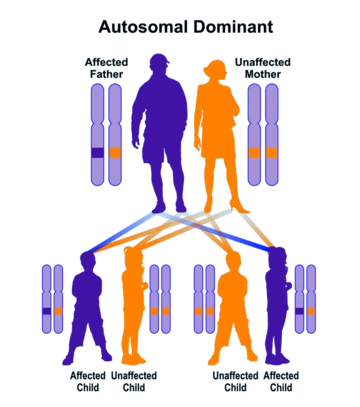
Autosomal dominant inheritance leads to a vertical pattern of transmission